How to track what you wear for 30 days using a hanger trick and a phone camera. The process takes four seconds each morning. By day thirty, you will have an honest receipt showing which slice of your closet actually gets dressed and which slice is home decor. That receipt ends the forty-minute morning spiral where every outfit becomes a committee meeting and you still leave in the same jeans. Here are the exact steps.
What you actually need (and what you can ignore)
A closet rod with hangers, a phone you already own, and a surface to jot a three-word note. Spreadsheets, color-coded stickers, and barcode scanners are all admirable, but they turn the experiment into a part-time job. If you have ever organized your closet by season, body type, or trend cycle and quit by Tuesday, the complexity was the enemy. The goal is evidence, not a boutique.
Some people prefer the notebook method. They write the date and the item in a pocket journal. That works if you carry a bag. Most people lose the journal by day four. The hanger flip requires no memory, no battery, and no handwriting. It also leaves the evidence in the closet where you cannot avoid it.
Step 1 — Reverse the hanger of everything you wear
On day one, turn every hanger in your closet so the hook faces you. When you wear something, hang it back the normal way. By day thirty, the hangers still facing you are the committee that never gets called. This is the only log you need for garments. It takes no extra time, no typing, and no willpower.
Psychologists study decision fatigue as the deterioration of choice quality after many small decisions. Every hanger flip is one less decision about whether to log the outfit. The physical motion becomes automatic by day three. By day ten, you will feel a small satisfaction snapping the hanger back to normal. That satisfaction is the habit looping.
Step 2 — Take one photo of your outfit before coffee
Before you leave the room, stand in the same spot and take one photo. Not a flat lay, not a mood board, not a mirror selfie with the flash on. Just proof that the clothes left the house. Save these to a dedicated album.
By day seven, you will notice repeats before the data tells you. The same black trousers will appear four times. You will start to see which shoes actually match real life and which ones only match your imagination. By day thirty, the album becomes a personal lookbook of outfits that passed the real-world test. It is also a useful defense against the orphan purchase. When you are tempted by a new blazer, scroll the album. If three outfits already work without it, you have your answer.
The photo does not need good lighting. It needs a timestamp. If you wear a cardigan three times in one week, the album will show you that cardigan is doing more work than the five jackets still facing you. That is the evidence you need when you are standing in a store holding a sixth jacket and convincing yourself it is different.
Step 3 — The Sunday five-minute audit
Once a week, open your photo album and count. Total wears. Unique items. Repeat offenders. Then walk to your closet and count the hangers still facing you. If the math feels brutal, that is the point.
| What to count | Where to find it | What it tells you |
|---|---|---|
| Total outfits worn | Phone album | Your real rotation size |
| Items worn 3+ times | Photo comparison | Your accidental uniform |
| Hangers still backward | Closet rod | The decorative 80% |
| New repeat offenders | Week-over-week scroll | What you actually trust |
Most people find that Week 2 is the uncomfortable week. The novelty wears off, and the backward hangers start to feel accusatory. That is normal. The discomfort is the data talking. Keep flipping.
The Pareto principle shows up in closets exactly where it shows up in business: roughly twenty percent of inputs drive eighty percent of results. Your job during the audit is not to fix the ratio. Your job is to see it without flinching.
Step 4 — Label the orphans
By day fourteen, you will spot the orphan purchases. The blazer with no known associates. The dress that only worked in the fitting room. The trend piece Instagram convinced you was timeless. Do not purge yet. Tag these items with a safety pin or a piece of tape. You are not sentencing them; you are filing a motion.
If an item stays pinned for the remaining two weeks, you have your verdict. This is the gentler cousin of decluttering a sentimental closet, but with data instead of therapy. The tape removes the drama. Either the item proves its worth or it enters evidence.
Step 5 — The rotation rule for week two and beyond
After the first audit, force one rotation. Pick one pinned item and wear it within three days. If it fails, it enters evidence. If it passes, it earns a regular hanger. This rule prevents the tracking experiment from becoming a museum of guilt.
The goal is not to shame the unworn clothes. The goal is to discover whether they are unworn because they have no friends in your closet or because you simply forgot they existed. That distinction matters if you want to stop the spiral of buying another beige sweater to solve the problem.
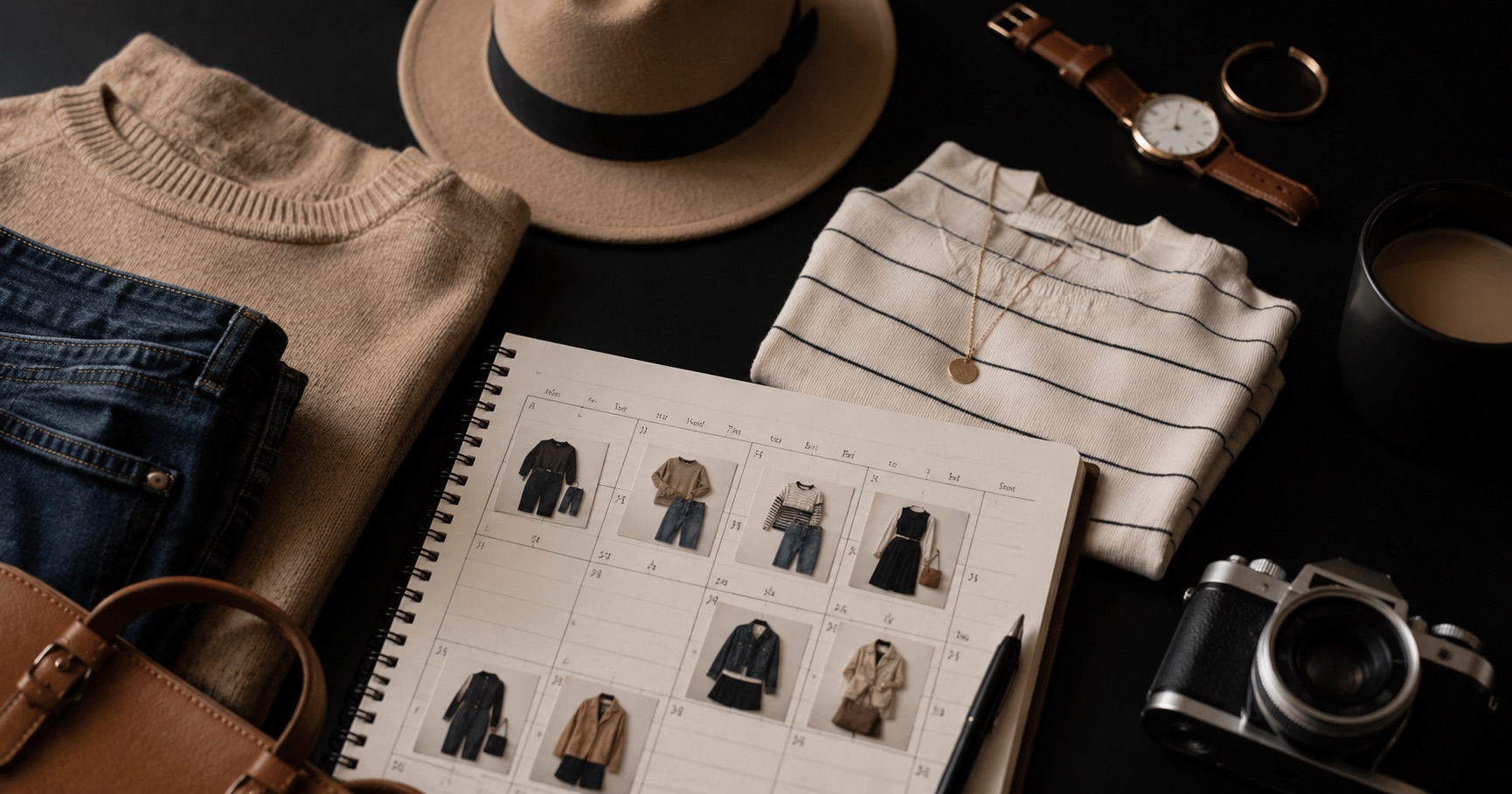
The 30-Day Wardrobe Planner takes three minutes to download and gives you a daily outfit map built around what you already own. Free.
Get the planner — it's free →Why 30 days is long enough
A month captures work, weekend, weather, and at least one laundry cycle. That is a full dataset. Anything shorter gives you a vacation bias; anything longer becomes a procrastination project. Thirty days also aligns with habit research suggesting four weeks is enough to detect a behavioral baseline without the tracker becoming the hobby. You are not trying to become a minimalist. You are trying to become someone who knows her own closet.
You will also hit at least one unexpected event: a dinner you forgot about, a heatwave, a day you spilled coffee and had to change. Those disruptions are useful. They show you what you reach for when your plan fails. That is the true test of a wardrobe.
What the data tells you on day thirty
Count the backward hangers. If more than half are still facing you, you are dressing from a fraction of your closet — and now you have the receipt to prove it. Start with the pinned orphans, keep the pieces that earned a forward hanger, and let the rest become someone else's useful statistic. You did not need a new app. You needed a month of honesty and a rod you had to look at every morning.
This is part of why I built DROBE. The app tracks what you actually wear instead of what you wish you wore, so you skip the hanger-flipping and go straight to the outfits that work. But the method above costs nothing and works with or without it. (If the deeper problem is that a full closet still feels empty, start with the real reason you have nothing to wear.)
Frequently asked questions
What percentage of your clothes do you actually wear?
Most people wear about twenty percent of their closet eighty percent of the time. The Pareto ratio shows up on the rod just like it does in a business, and a 30-day track usually confirms it within the first two weeks.
What is the easiest way to track what you wear without an app?
The backward-hanger trick. Turn every hanger to face you on day one, then flip it the normal way each time you wear something. The hangers still facing you at day thirty are the clothes you never reach for.
How long should you track your wardrobe?
Thirty days. It captures work, weekend, weather, and at least one full laundry cycle without turning into a hobby you abandon by Tuesday.
Does tracking what you wear actually reduce decision fatigue?
Yes. Once you can see your real rotation, the morning stops being a committee meeting. You already know which handful of pieces do the work, so the choice shrinks to something a tired brain can handle.
Do you need a special app or spreadsheet to do this?
No. A phone camera and your existing hangers are enough. Spreadsheets, stickers, and barcode scanners just add friction, and most people quit within a week.
Soleo Technologies builds DROBE — the AI stylist that dresses you from your own closet. Less war. More wear.