Everyone says color-coded hangers end the morning standoff. They don't. Organizing your closet won't fix your wardrobe because the problem was never filing. It was curation. A closet full of orphans arranged by season is still a closet full of orphans. Decision fatigue lives in the selection, not the sorting. Until you know what actually gets worn, any system is just expensive staging for clothes that don't speak to each other.
Organized clutter is still clutter.
Why do color-coded rails still leave me with nothing to wear?
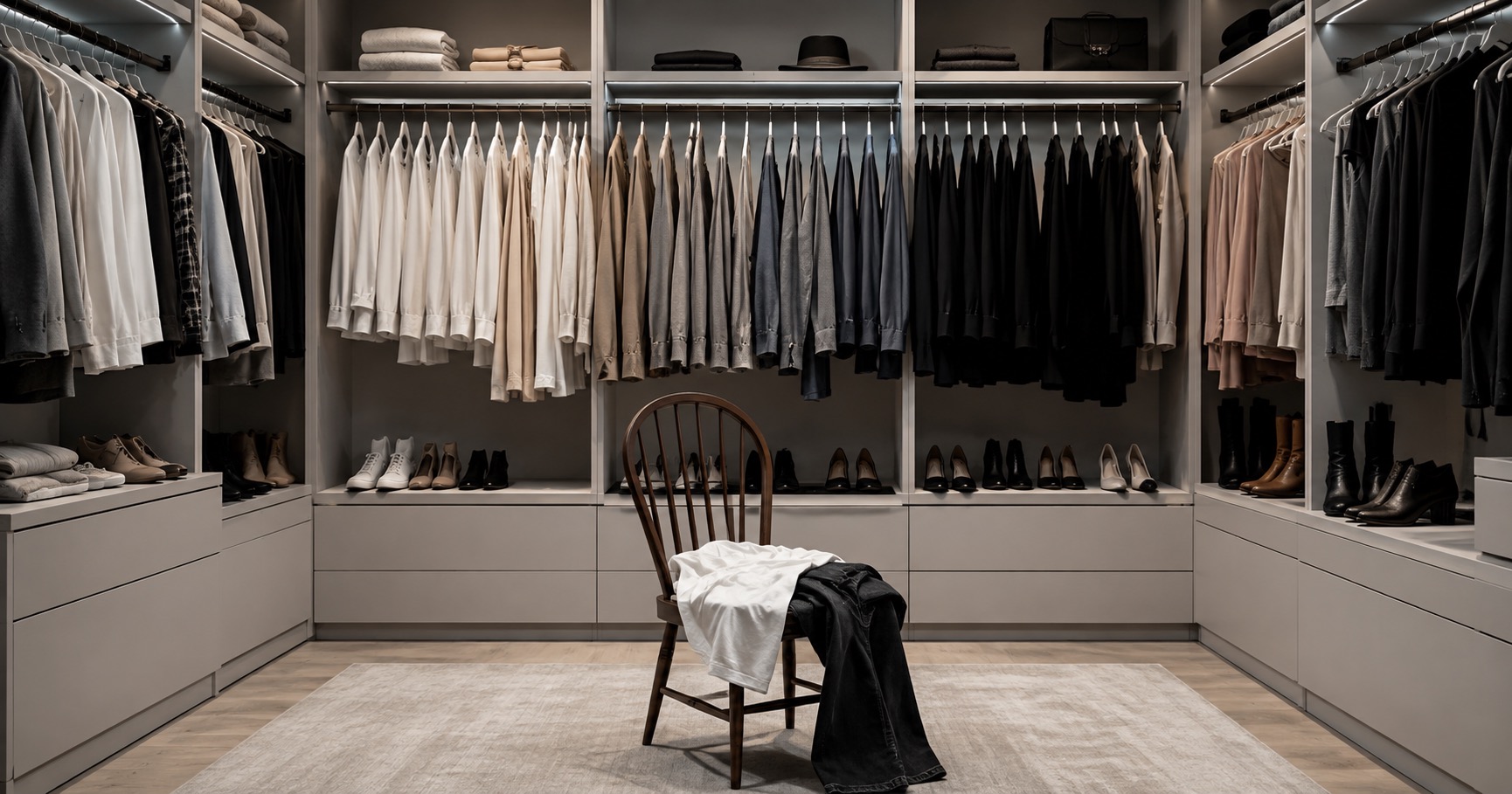
I once spent six hours matching hangers and sorting by sleeve length. Monday morning, I stood in front of a very neat rail and reached for the same black trousers. The system looked beautiful. My outfit options were identical.
Psychologists call this decision fatigue — the deterioration of quality after a long series of choices. When every shirt is visible but only three fit your actual life, visibility makes the problem worse. You see the inventory of your past mistakes in sharp focus. Research on decision fatigue shows that more options, even tidy ones, drain the same cognitive battery.
Visibility is not viability.
What is the real problem if it isn't messiness?
The clutter industry sells the fantasy that a clear bin changes your behavior. It doesn't. The real issue is wardrobe orphanage: pieces bought without a plan, hanging in pristine order, with no known associates. That satin blouse looks lovely on its velvet hanger. It has nothing to say to your bottom half.
You do not have a storage crisis. You have a curation crisis. Organizing preserves the illusion that you will one day wear the lime-green blazer. It gives every bad purchase a label and a home. The hangers are innocent. The file system is fine. The defendant is the contents.
Why does organizing feel like progress when it isn't?
Because it mimics control. Rearranging is emotionally safer than admitting a purchase was a mistake. The container store receipt feels like an investment in your future self. Future You, however, still has to get dressed. This is the sunk-cost fallacy wearing a label maker. You organize to avoid deciding.
Rearranging is not repentance.
How to tell if you organized instead of edited
Three symptoms separate storage from strategy:
| Symptom | What it actually means |
|---|---|
| You own 50+ tops but wear the same six | The accidental uniform is hiding inside the archive |
| You can describe your closet by color but not by outfit | You curated a display, not a wardrobe |
| New containers outnumber items removed | Hoarding with better branding |
If this sounds familiar, you filed what you should have fired. Most people who feel they have nothing to wear are not messy; they are overstocked. You likely wear a fraction of what you own. The bins simply gave the other ninety percent a nicer prison.
The single-rail test: what actually moves the needle
Stop buying bins. Pull every item you have worn in the last thirty days onto a single rail. Put the rest in a box under the bed. Wait two weeks.
You will discover two things. First, your real wardrobe is about twelve pieces. Second, those twelve pieces do not need an organizing system. They need company.
This is not minimalism. It is evidence. When you see your actual uniform isolated from the decoys, you stop asking what to wear and start asking why you own the other eighty percent. If you want to go further, track what you actually wear for a full month. The data is harsher than any velvet hanger.
After two weeks, open the box. If you cannot remember what is inside without looking, you have your donation list. If you reach for something specific, it earns its way back onto the rail — but only if it creates an outfit with the existing twelve. Otherwise it is evidence, not inventory.
Evidence suggests otherwise.
The Outfit Roast gives you an objective verdict on what to keep and what to cut — not another storage tip. Two minutes, free.
Roast my closet — it's free →Does decluttering come before organizing?
Always. Organizing is the last step, not the first. You cannot alphabetize a vocabulary you don't want to speak. The sentimental tax on shelf space is real, but that is a separate operation. If you need permission to release the dress from 2019, read this on how to declutter when you're sentimental.
But sentiment aside, most unworn clothes are simply draft picks that didn't make the team. Filing them by position does not put them in the game.
If you want an objective verdict on what actually deserves rail space, the Outfit Roast takes two minutes and it's free.
When an organizer is worth hiring
After the single-rail test. Only after. A professional who edits before she alphabetizes is a curator. One who alphabetizes your mistakes is an accomplice. Hire someone to build systems for clothes you actually wear, not to stage a memorial for the person you thought you would become.
(This is part of why I built DROBE — The Eye counts your actual rotation, not your bin labels. But the single-rail test works with or without it.)
Frequently asked questions
Why do I still have nothing to wear after organizing?
You sorted items, not outfits. Organization makes inventory visible; it does not create wearable combinations or fix orphan pieces.
Should I declutter before or after I organize my closet?
Before. Organizing air for clothes you do not wear is set design, not strategy. Edit first, then store.
How do I organize a small closet with too many clothes?
You do not organize it; you edit it first. Any system stuffed beyond capacity will fail, regardless of bin quality.
Does color-coding help with outfit planning?
It helps visually. It does not generate wearable combinations or turn orphan purchases into functional wardrobe pieces.
What is the single best closet organization tip that actually works?
Own fewer clothes that you do not wear. After that edit, any hanger system works.
Soleo Technologies builds DROBE — the AI stylist that dresses you from your own closet. Less war. More wear.