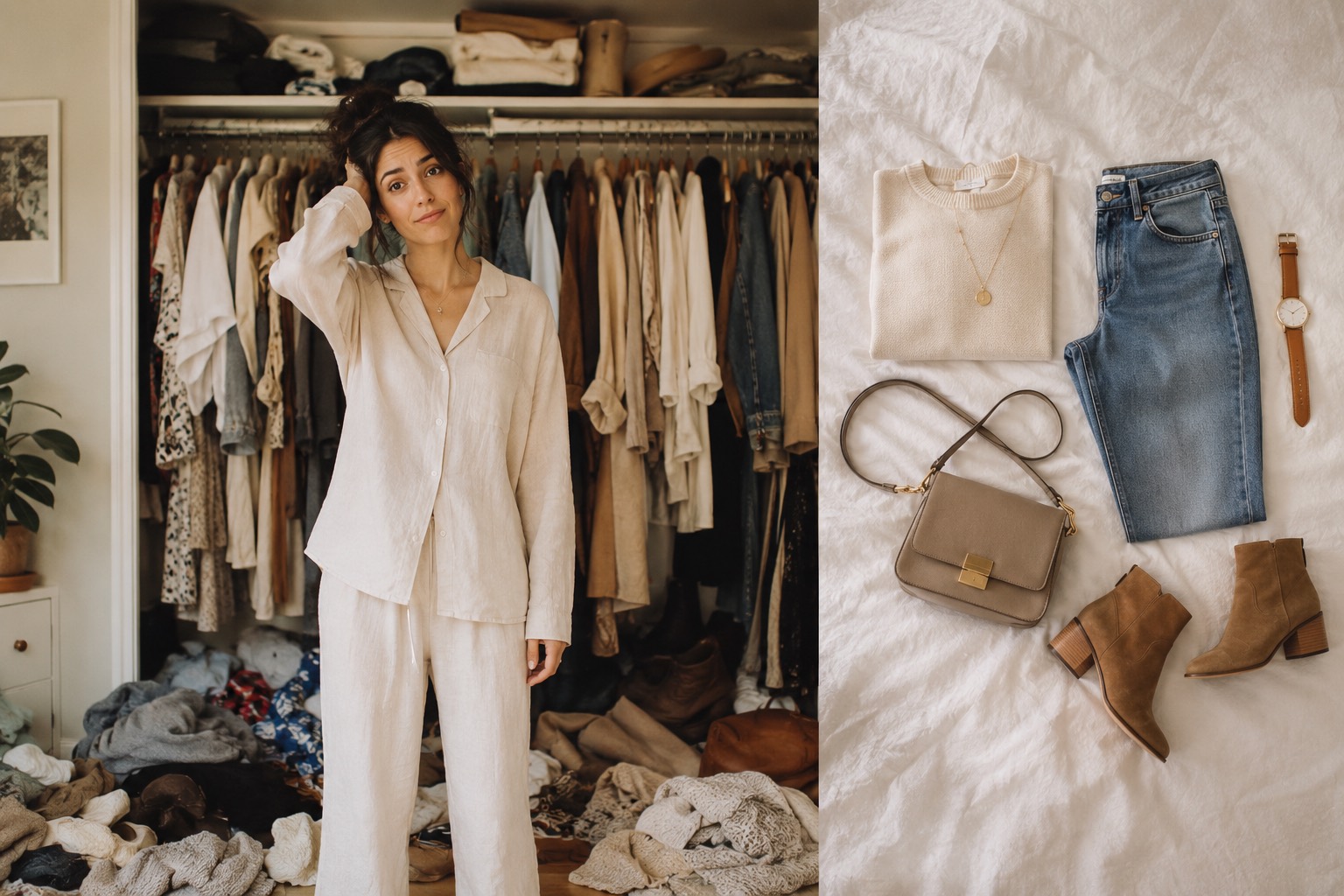
You're standing in front of a closet packed with clothes. You have a full rack of tops, three drawers of denim, a shelf of shoes you forgot existed. And yet — nothing to wear.
Sound familiar? You're not alone, and you're not crazy. This is one of the most common experiences women have, and it has nothing to do with not owning enough clothes. It has everything to do with how your wardrobe is working (or not working) for your actual life.
This guide breaks down exactly why it happens, what's really going on in that closet, and the outfit planning system that ends the morning war for good. Bookmark it. You're going to come back to it.
Why "nothing to wear" is almost never about clothes.
Let's get this out of the way first: you almost certainly have enough clothes.
Research consistently suggests that the average woman wears only about 20% of what she owns on a regular basis. If you have 100 items in your closet, you're probably cycling through 20 of them. The other 80 exist in a kind of wardrobe limbo — not quite right, not quite gone, just taking up space and adding mental noise every single morning.
So the real question isn't "what should I buy?" It's "why am I ignoring 80% of what I already own?"
The answer usually comes down to three things:
1. Your closet doesn't reflect your real life.
A lot of us dress for a life we used to have, a life we aspire to, or a life we imagine having someday. There are work blouses from a job you left three years ago. Heels bought for an event that never recurred. Dresses that fit perfectly in the dressing room but don't fit your Monday morning.
When your closet is out of sync with your day-to-day reality, nothing feels right — because nothing is right for the life you're actually living.
2. You don't know what you own.
This sounds obvious, but it's true. When clothes pile up over years of impulse buys, sale hauls, and gifted items, you lose track of what's actually in there. You reach for the same 10 pieces on autopilot because they're visible, accessible, and proven. Everything else becomes invisible.
Invisible clothes don't get worn. It's that simple.
3. You have clothes, not outfits.
Here's the real kicker: a closet full of individual pieces isn't the same as a closet full of outfits. You might own 40 tops and 15 bottoms, but if they don't actually combine into something you'd leave the house in, you still have nothing to wear.
This is the gap between accumulating and curating. And it's where most wardrobes fall apart.
The "closet full, nothing to wear" trap (and how you got there).
Understanding the trap is step one to escaping it.
Here's the cycle most of us are stuck in:
Feel like you have nothing to wear → buy something new → wear it twice → it disappears into the closet → feel like you have nothing to wear again.
Every time you buy something to solve the "nothing to wear" feeling, you're treating a symptom, not the cause. You're adding one more item to a system that's already broken. The result? More clutter, more decision fatigue, more paralysis.
Fast fashion and trend cycles make this worse. When you're buying based on what's new rather than what works, you end up with a closet full of pieces that each seemed exciting in isolation but don't connect to anything else you own.
The fix isn't a shopping ban (although a pause can help). The fix is a system.
Step 1 — Do the honest closet audit.
Before you can build an outfit planning system, you need to see clearly what you're working with.
Pull everything out — yes, everything — and ask three questions about each item:
1. Have I worn this in the last 12 months?
If no, why not? Is it the wrong size? The wrong vibe? Uncomfortable? Waiting for an occasion that never comes? Be honest with yourself.
2. Does this fit my actual life right now?
Not the life you had. Not the life you want. Your life on a Tuesday in 2026. Does this item show up there?
3. Does this go with at least three other things I own?
A piece that only works with one specific outfit is a trap (run the cost per wear if you doubt it). Versatility is the magic word. If you can't immediately think of three combinations, that item is probably working against your wardrobe.
Anything that fails two or three of those questions is a candidate for the donate pile — or at minimum, a separate "maybe" box you revisit in 60 days.
This is uncomfortable the first time. Do it anyway.
Step 2 — Identify your actual wardrobe gaps (vs. imaginary ones).
After your audit, you'll have a much clearer picture. And here's what most women find: they don't have gaps where they thought they did.
You thought you needed more tops. What you actually need is one good pair of straight-leg trousers that goes with the six tops you already own. You thought you needed more shoes. What you actually need is a white sneaker that grounds your summer dresses and casual jeans.
The audit makes the real gaps visible. And real gaps are easy to fill intentionally — one or two targeted purchases instead of a $300 shopping haul that doesn't solve anything.
Write your gaps down. A short, specific list. "Neutral flat that works with dresses and denim" is infinitely more useful than "I feel like I need more shoes."
Roast My Closet is exactly what it sounds like. Show it your wardrobe; it tells you the truth. Free, brutal, over in two minutes.
Get roasted — it's free →Step 3 — Build your outfit formula.
Here's something nobody tells you: personal style isn't about being creative every day. It's about having a reliable formula you can trust and remix endlessly.
A basic outfit formula looks like this:
Bottom + Top + Layer + Shoe = Complete Look
Your variables within each category are limited to things that actually work for your life and body. Once you know your formula, getting dressed stops being a creative exercise and starts being a system.
For example:
- Casual formula: Straight-leg jeans + fitted tee + oversized blazer + white sneaker
- Work formula: Tailored trousers + tucked blouse + loafer
- Weekend formula: Midi skirt + simple knit + ankle boot
You're not wearing the same outfit every day — you're rotating through proven combinations with confidence, because the combinations are known to work.
Capsule wardrobe thinking lives here: fewer pieces, more outfits, less noise.
Step 4 — Solve the morning problem.
Even with a better closet and a solid formula, mornings are still brutal for a lot of women. The problem isn't the clothes — it's the decision at 7 a.m. when your brain hasn't fully loaded yet.
The research on decision fatigue is real: every small decision you make depletes cognitive energy. When you're deciding what to wear at the start of the day, before coffee, potentially running late, with three other things on your mind — you're starting from a depleted state.
The solution: make the decision before morning.
This can look like:
- Weekly outfit planning. Sunday, 15 minutes, five looks laid out and photographed.
- The night-before prep. Outfit hung out the night before, no decisions in the morning.
- A digital closet system. Your actual clothes catalogued so you can browse combinations without standing in front of the rack.
That last one is where technology has finally caught up to the problem.
Why an AI stylist changes everything.
Outfit planning apps have existed for a while, but most of them just digitize your wardrobe and leave you to do the work. You catalog your clothes, and then... you still have to figure out what to wear.
What's different — and what actually solves the problem — is an AI that knows your closet, remembers what you've been wearing, notices what's being ignored, and actively dresses you.
That's the gap DROBE was built to fill.
DROBE's AI stylist — called The Eye — doesn't just show you what you own. It sees patterns. It knows you've worn the same three pieces for two weeks while 80 items collect dust. It calls that out. It builds you an outfit from what you actually own, not from a Pinterest board or a stylist's fantasy closet.
It also has a social layer — which is genuinely different from anything else out there. You can follow other women, see how they're styling real pieces from real wardrobes (not curated influencer looks), and get styled by each other. It's community meets closet meets AI.
If morning dressing feels like a war right now, this is built for you. Join the waitlist here — 7 days free when it launches.
The outfit planning habit that sticks.
Let's be practical. Systems only work if you actually use them. Here's the simplest version of an outfit planning habit that doesn't require willpower to maintain:
The Sunday 15 (or the Thursday 10).
Once a week, take 10–15 minutes to look ahead at your week. What's actually happening? Work meetings, casual days, one dinner out, errands? Map a rough outfit to each scenario — not a rigid uniform, just a direction.
The benefits are immediate:
- No morning panic
- You actually wear more of your wardrobe (because you're making intentional choices, not autopilot reaches)
- You spot gaps earlier ("I need to do laundry before Thursday")
- You feel more put together, which has a knock-on effect on how you carry yourself all day
Small habit. Disproportionate payoff.
Quick reference: the "nothing to wear" fix in 5 steps.
If you want to cut to the chase:
- Audit honestly. Pull everything out. Ask the three questions. Remove what doesn't belong.
- Find real gaps. Not imaginary ones. Write a specific list.
- Build your formula. Bottom + Top + Layer + Shoe. Know your three go-to versions.
- Plan ahead. Weekly, nightly, or with an app — remove morning decisions.
- Use what you own. The goal isn't a better closet. The goal is more outfits from what you already have.
What comes next.
This guide is the foundation. Over the coming weeks, we're going into deeper detail on each part of the system:
- The complete “I have nothing to wear” guide (audit, plan, rotate)
- How to do a proper capsule wardrobe edit (without losing everything you love)
- The outfit formula for women who hate getting dressed
- How to build a work wardrobe that actually works for your Monday–Friday
- Using an AI stylist: what it actually does vs. what the hype says
Every post links back here, because this is home base. Bookmark it, save it, share it with a friend who sends you "I have nothing to wear" texts at 7:45 a.m.
And if you want to skip straight to the solution — DROBE is waiting for you.
Soleo Technologies builds DROBE — the AI stylist that dresses you from your own closet. Less war. More wear.